Marking the final week before the winter break, week 6 was dedicated to finalising the tutu plate and doing any prep work so I can continue with this over the holidays. Now that all layers are attached and sewn to the basque, the centre back of the knickers is finished with a French seam. All layers are then sewn closed halfway up the back seam apart from layer 7 which needs to remain open until the hoop wire is inserted into the channel.

Before putting the hoop wire into the channel sewn on layer 7, the ends of the wire were wrapped in tape so that it doesn’t damage the tulle or the person wearing the tutu and the layers above layer 7 were held to the body of the mannequin, wrapped in spare netting, to make it easier to feed the wire through the channel. A pen cap was also used on the end of the wire to help guide it through the channel, alternately pushing the wire and pulling the netting until the wire is pushed all the way through. Once the wire is pushed through fully, the exposed wire was then joined by wrapping spare netting tightly around it 2-3 times. The netting was then secured with a cross stitch, preventing the wire from springing apart and hurting anyone during a performance.
The penultimate step in constructing the tutu plate was flat-felling the crotch seam. This was not easy to do because I had to squeeze some of the layers under the machine too so the seam isn’t quite as straight as I would like it to be.
Now the mass of tulle is finally starting to look like a tutu and it is very exciting at this stage. Before I could do any more though, I had to flatten the tutu. We did this by using a giant wooden board and placing sewing machines on top to weight it down. It has to be left for at least 24 hours like this to flatten properly and it is very satisfying when you lift the board and the tutu plate stays flat, instead of springing up as you would expect it to.
This is the moment I have been waiting for, to finalise the pattern of the bodice with the tutu plate for context. With the tutu plate complete, I drew a paper pattern to see if I could build the lower shaping of the bodice as a separate piece that could be sewn on. I have to say, this looks much nicer than when I attempted to build the shaping from the basque and this is definitely what I will use moving forward. Although only paper, the shape of it flows really nicely from the plate and around to the back of the bodice.
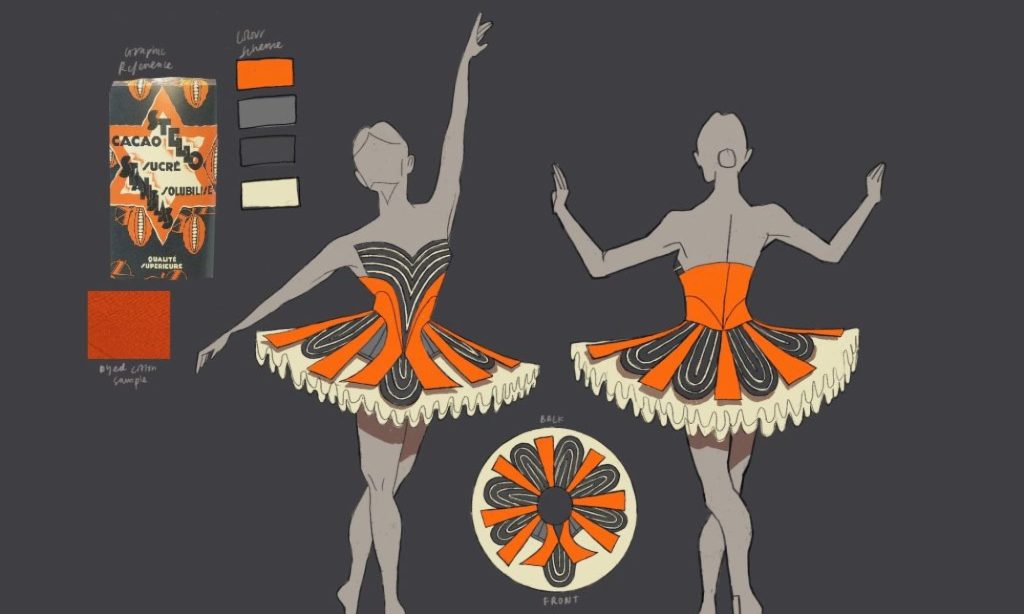
Before packing to go home that night I found a scrap piece of fabric that is the perfect size for the orange decorations on the plate so I have made a pattern from it and will use that to cut the fabric from. I am really pleased with how it slightly tapers to the outside.
The last pattern to make was the navy petal decorations and I drew these using a French curve to get smooth lines. I then placed it between two of the patterns for the orange decorations and adjusted until the pattern matched the design. The bodice and bodice decoration were also on the mannequin at this point and it was nice to gauge an idea of how the finished tutu might look.
Before taking my things home for the holidays, I wanted to at least have the bodice sewn together. the first stage of this was cutting the patterns from the top fabric and backing fabric, marking the backing fabric, and then tacking the two together. Tacking the velvet to a stable fabric like this helps to reduce the wrinkles and gives the fabric a smoother appearance.
With all panels tacked to their respective backing fabrics, they were sewn together and all raw seams overlocked.
Et voila! The base of the bodice is sewn together before I go home for the holidays. I do feel it’s a little loose at the front so I might adjust that at a later date but for now it is looking good and I am really happy to see it finally taking shape.